-
About Assam...
Assam is described as “The land of red river and blue hills”, has a unique landscape with sprawling tea gardens and unending stretches of paddy fields interspersed with groves of coconut, areca nuts, and banana trees. Assam is popular for Assam tea, petroleum resources, Assam silk and for its wide biodiversity. Located to the north east side of India and to the south of the eastern Himalayas, Assam along with other states: Arunachal Pradesh, Nagaland, Manipur, Mizoram, Tripura and Meghalaya are known as seven sisters and it is surrounded by them. It comprises the Brahmaputra and the Barak river valleys and the Karbi Anglong and the North Cachar Hills. Actually the Assam’s area is almost equivalent to the size of Ireland or Austria. The population is a mixture of different races and tribes like the Austrics, the Aryans, Negroids, Indo-Burmese, Indo-Tibetans and Mongoloid which they have enriched each other to give a distinctive identity to the Assamese people. The language is akin to Bengali, spoken in West Bengal and Bangladesh.
Assam has a gross cropped area of about 85 lakh hectares with more than 78% accounting for areas covered by food grain crops. Jute, tea, cotton, potato, sugarcane, oilseed etc. Are the major cash crops. Orange, banana, pineapple, arecanut, coconut, guava, mango and jackfruit are major horticulture items. About 74 per cent of the states working force is engaged in agriculture and allied activities.
Places To Visit...
Kamakhya Temple
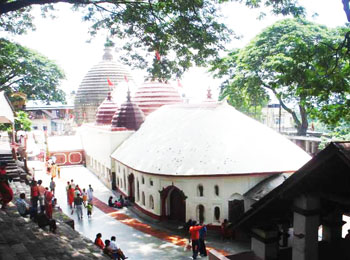
Kamakhya Temple on Nilachal Hill, eight km west of the city is believed to be an ancient 'Khasi' sacrificial site. It has been a part and parcel of Assamese life and culture from ancient times. The temple dedicated to the Goddess Kamakshya is one of the oldest and most sacred centre for Shakti worship and Tantric Hinduism. The original 10th century temple was destroyed by Muslim converts but was rebuilt in 1665 by King Naranarayana of Koch Bihar. The sikhara or spire is in the shape of a beehive and it has the nymph motifs and the long turtle back hall. The stone images and other relics found around the temple have been dated by archaeologists to the eighth century onwards. It attracts pilgrims from all over India, especially during the Ambubachi Festival which usually falls around July. The ponds here are home to some giant turtles. There is a majestic view of the city and the Brahmaputra river from the hill top. Non-Hindus are not allowed to enter the sanctum.
Basista Ashram
Situated in the southern-most rim of Guwahati city on the Sandhyachal hill is a well known holy cum picnic spot, called Basisthashram, after the great vedic Sage Bashistha, who is said to have lived here. Three rivulets named Sandhya, Lalita and Kanta meet here and flow perenially adding scenic grandeur to the place. It is 12 Kms. from the Guwahati Railway Station. City buses ply regularly to the Ashram.
Assam State Museum
The Assam State Museum has collections of archaeology, sculpture, paintings, metal, ivory and woodwork, costumes and ethnology. There are exhibits of reconstructed huts of Assamese tribes. You can walk right through these village huts. There are also displays of weavings and musical instruments. It is open from 1000 to 1630 from Tuesday to Saturday and 0800 -1200 on Sundays. Closed on Mondays and second Saturdays.
The Surya Pahar Temple
situated in Goalpara in Assam. It is an ancient center of sun worship and there are numerous insufficiently explored archaeological remains around it.
Chandubi Lake
A natural lagoon and fine picnic spot which is 64 kms. from Guwahati. The lake and its surroundings is an ideal holiday resort with the added attraction of fishing and rowing. The place is easily accessible by bus from Guwahati.The best season to visit is from November to April.
Sualkuchi
Assam produces three unique varieties of silks, the Golden Muga, the White Pat and the warm Eri. Silks grown all over the state find their way to Sualkuchi, 32 kms from Guwahati. Sualkuchi is one of the world's largest weaving villages often called the Manchester of the East. The entire population here is engaged in weaving exquisite silf fabrics. A renowned centre of silk production, particularly known for Muga - the golden silk of Assam which is not produced anywhere else in the world.
Sibsagar
Sibsagar is 369 kms. towards the east of Guwahati and is the headquarters of a district of the same name. It is also a leading tea and oil producing district. The Eastern Regional Headquarter of the Oil and Natural Gas Commission is located at Nazira, 18 kms. from Sibsagar. Modern Sibsagar is a fast developing town. The highest Shiva temple in India, situated in the heart of Sibsagar, which was the capital of the Ahom dynasty. Sibsagar was the capital of the Ahoms who ruled Assam at a stretch for six hundreds years before the advent of the British. It is a beautiful town located around the huge Sibsagar tank, an artificial lake constructed by Queen Madambika in 1734 A.D. The Shiva idol or Shiva Temple on the bank of this tank is believed to be the highest Shiva temple in India.
Majuli
Assam is famous for Majuli, the world's largest river island. Majuli situated in the midst of river Brahmaputra, is the centre of Vishnava culture. The total area of Majuli has been steadily decreasing due to strong erosion of the river Brahmaputra. The area of the island has reduced from 2,82,165 acres in 1853 to less than 886 sq. kms today. There are over fifteen Vaishnava monasteries or satras on Majuli. Auniati is famous for its considerable collection of Assamese old utensils, jewellery and handicrafts. Upper Majuli is inhabited by tribes like the Mising and the Deoris and is the centre of a living heritage of colourful costumes and festivals. Plenty of migratory birds of great varieties are also seen here.
Barpeta Satra and Kirtanghar
In addition to the Satras, the most striking monument to the genius of Sankaradeva and his chief disciple Madhav Deva is the Kirtanghar at Barpeta in Kamrup district which was the centre of their activity for many years. This famous Shrine and Kirtanghara attracts Vaishanavas from all over India. It was established by Madhadeva, the greatest disciple of Shankardeva.
Kaziranga National Park
The first and the oldest National Park in Assam situated in Golaghat District, is a World Heritage site. Spread over an area of 430 sq. kms., Kaziranga National Park is the natural home of the one-horned Indian rhinoceros. Declared a National Park in 1974 the landscape of Kaziranga is of sheer forest, tall elephant grass, rugged reeds, marshes and shallow pools. The one horned Rhinoceros, Elephant, Indian bison, Swamp Deer, Samber, Hog Deer, Sloth Bear, Tiger, Leopard cat, Jungle cat, Hog badger, Capped langur, Hollock gibbon, Jackal, Goose, Hornbills, Ibis, Cormorants, Egret, Heron fishing eagle etc. all form a part of the very complex ecological balance of the park.
Manas National Park
The only Tiger Project in Assam, Manas is one of India's most magnificent National Parks. It is situated on the bank of the river Manas at the foothills of the Himalayas. It is a well known World heritage site with it's unique combination of scenic beauty and rare wealth of wildlife. Covering an area of 519.77 Sq. Kms, it has a core area of 360 Kms and is situated in Barpeta District. Manas is one of the nine tiger reserve sanctuaries in India. Tigers however are not the only wildlife to be found here. Manas has its own peculiar faunal features, the rarest species of which are Hispid Hare, Pigmy Hog, Golden Langur, Indian Rhinoceros, Asiatic Buffalo etc.
- .